

ManiSoft D
AI benchmark · Robotics
Full listing name: ManiSoft: Towards Vision-Language Manipulation for Soft Continuum Robotics
What is ManiSoft?
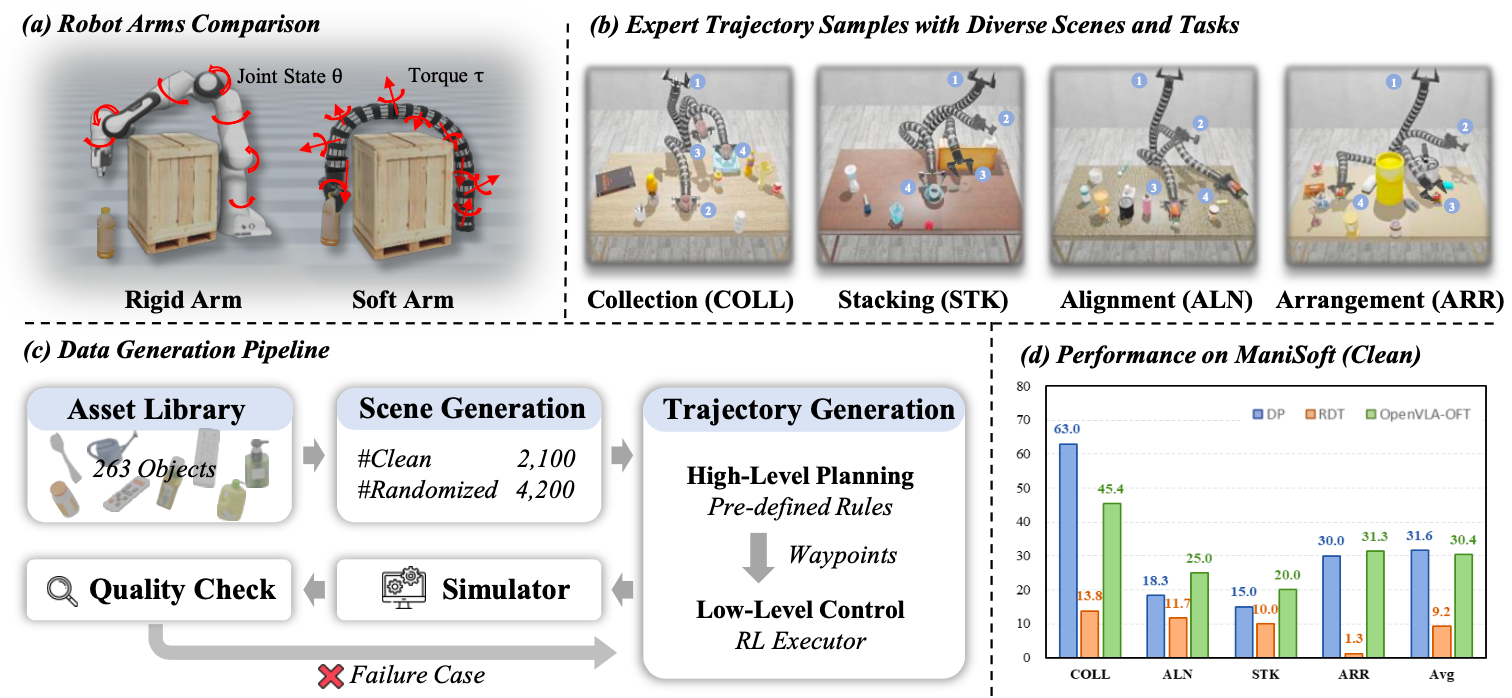
Most existing vision-language manipulation research targets rigid robotic arms, whose fixed morphology limits adaptability in cluttered or confined spaces. Soft robotic arms offer an appealing alternative due to their deformability, but confront challenges such as unreliable proprioception and distributed low-level actuation. To investigate these challenges, we introduce \ManiSoft, a benchmark for vision-language manipulation with soft arms. ManiSoft features a tailored simulator that couples realistic soft-body dynamics with contact-rich interactions via an elastic force constraint. On this basis, ManiSoft defines four tasks, each highlighting distinct aspects of deformable control, from basic end-effector coordination to obstacle avoidance. To support policy training and evaluation, \ManiSoft{} includes an automated pipeline that generates $6{,}300$ diverse scenes and corresponding expert trajectories. To produce high-quality trajectories at scale, we first employ a high-level planner to decompose each task into a sequence of waypoints, followed by a low-level reinforcement learning policy that generates torque commands to track waypoints. Benchmarking three representative policy models shows relatively promising results in clean scenes but substantial performance drop under randomization. Visualization analysis indicates that failures stem primarily from inaccurate visual estimation of proprioceptive state and limited exploitation of deformability for adaptive obstacle avoiding. We anticipate ManiSoft to serve as a valuable testbed, bridging the gap between rigid and soft arms in the context of vision-language manipulation. Out codes and datasets are released at https://buaa-colalab.github.io/ManiSoft.
Tier D · a leaderboard, listed apart
Long tail: little or no usage data yet.
How much stands behind a tier: usage, who backs it, a confirmed line from its own site or paper, and a clear read on X. High with three of the four, medium with two, low otherwise.
- 4 models scored
- fewer than 5 models scored
- in curated RL directories (1 pt)
How we got to tier D
- Adoption: 4 models scored; fewer than 5 models scored. Tier D.
- Not yet read on X.
- In curated RL directories: 1 point, a floor of none.
- Not yet confirmed by a line from its own site or paper.
- Judged a leaderboard, arena or index rather than one benchmark (or not a benchmark at all): listed apart.
A clear view on X moves a tier one step up or down; most entries don't move. How tiers work.
Not on the map yet: no line from its own site or paper places it in a domain.
Next: browse all benchmarks. Entry from the RL Research daily scrape of public sources, 2026-10-11 snapshot.