


PRISM C
AI benchmark · Reasoning
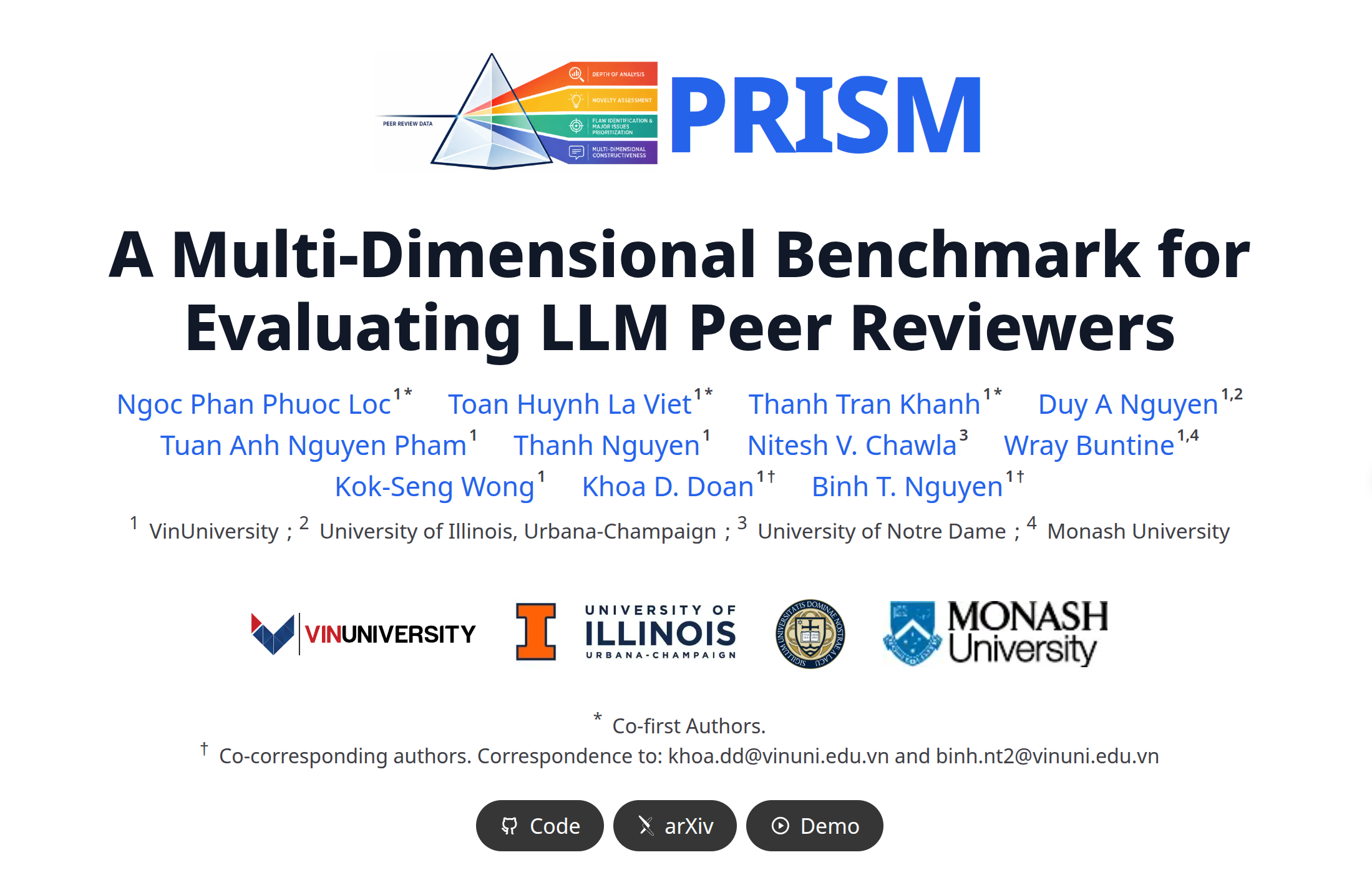
Full listing name: PRISM: A Multi-Dimensional Benchmark for Evaluating LLM Peer Reviewers
What is PRISM?
The rapid growth in submissions to machine learning venues has strained the scientific peer-review system and intensified interest in LLM-based automated peer reviewers. However, how good these systems are actually, especially compared to human reviewers at catching scientific gaps, remains poorly understood. In this work, we introduce PRISM (Peer Review Intelligence via Structured Multi-dimensional assessment), a benchmarking framework that evaluates review quality across four dimensions: Depth of Analysis, Novelty Assessment,Flaw Identification & Major Issues Prioritization, and Multi-dimensional Constructiveness. Unlike most existing evaluations based on surface-level metrics like ROUGE and BLEU, or unconstrained LLM-as-a-judge prompting that conflates fluency with rigor, PRISM grounds each dimension in argument mining, retrieval-augmented verification, and consensus-based scoring. We apply PRISM to benchmark five leading automated reviewer systems and human reviewers on a stratified corpus of reviews from ICLR, ICML, and NeurIPS. The results reveal that LLMs can match or beat human reviewers on individual dimensions: comparable depth of analysis, stronger novelty verification, and highly accurate critique prioritization. However, no single system consistently matches the balanced performance of the human baseline across all dimensions at once. Each exhibits a distinct specialization profile with characteristic blind spots -- failure modes that aggregate metrics miss entirely. The implication is that LLM reviewers are best understood as targeted supplements to human review, effective within specific dimensions, but unreliable as standalone replacements. Our demo and key results can be found at https://khanhthanhdev.github.io/prism-page/.
Tier C
Niche: a handful of models scored, or built by an RL vendor.
How much stands behind a tier: usage, who backs it, a confirmed line from its own site or paper, and a clear read on X. High with three of the four, medium with two, low otherwise.
- 7 models scored
- in curated RL directories (1 pt)
How we got to tier C
- Adoption: 7 models scored. Tier C.
- Not yet read on X.
- In curated RL directories: 1 point, a floor of none.
- Not yet confirmed by a line from its own site or paper.
A clear view on X moves a tier one step up or down; most entries don't move. How tiers work.
Not on the map yet: no line from its own site or paper places it in a domain.
Next: browse all benchmarks. Entry from the RL Research daily scrape of public sources, 2026-10-11 snapshot.