

SpaceReject D
AI benchmark · Embodied
What is SpaceReject?
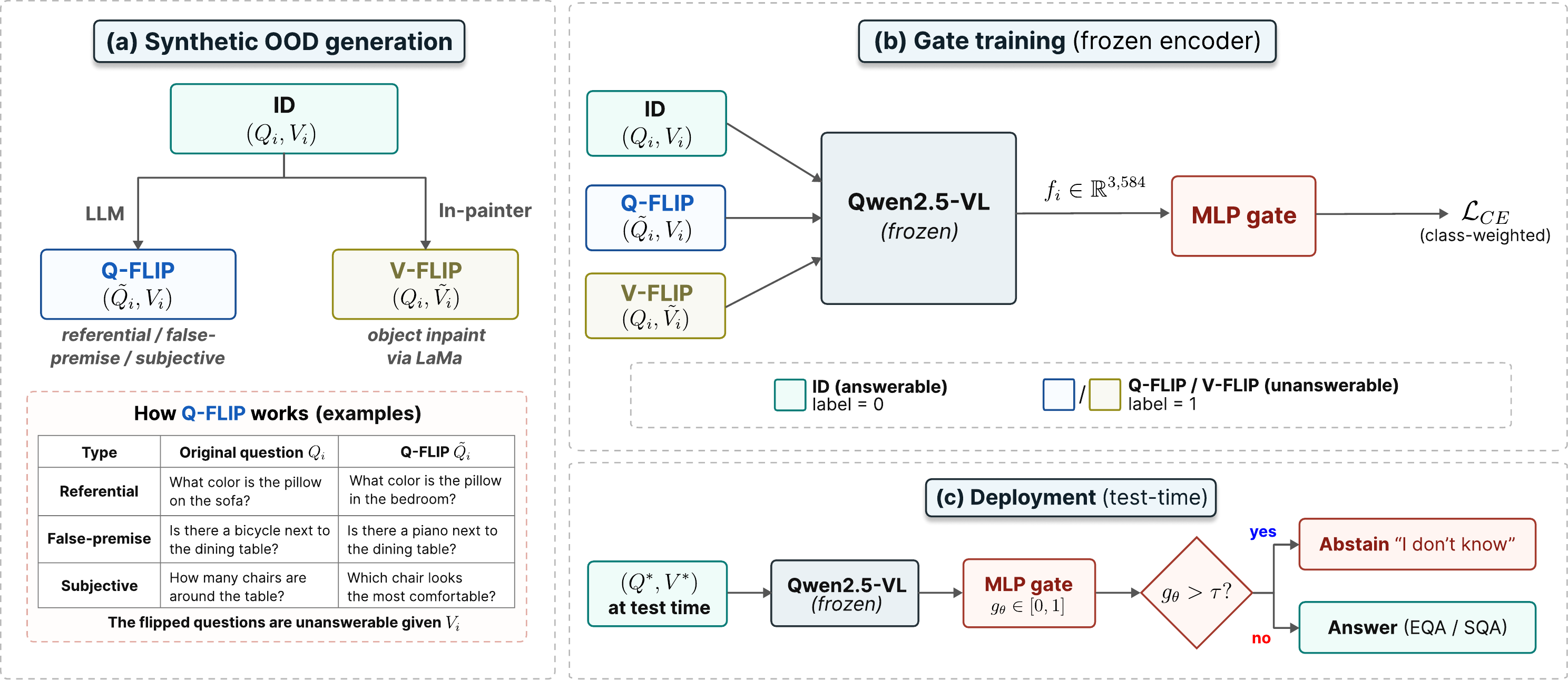
Detecting unanswerable user queries remains essential for the reliable deployment of real-world embodied agents. However, modern vision-language models (VLMs) often generate overly confident answers even when the available visual memory cannot support the query. Such overconfidence poses various task-dependent risks. The agent may provide misleading information to the user in Embodied Question Answering and select an arbitrary coordinate and physically guide the user there in spatial reasoning for navigation. Despite these high stakes, only a few prior studies directly address when and how an embodied VLM should respond with "I do not know." This work proposes Semantic Flip, a simple yet effective framework that synthesizes auxiliary out-of-distribution (OOD) samples for embodied refusal without requiring external OOD annotations. The key idea is to independently transform the query and video memory to construct auxiliary OOD pairs that lack sufficient visual grounding. These synthesized pairs enable training a lightweight rejection module on top of a frozen pretrained VLM. The module attaches to any existing VLM-based pipeline without retraining the underlying model. Across two complementary benchmarks, Semantic Flip consistently outperforms strong prompting baselines. This work also introduces SpaceReject, a new refusal benchmark for spatial localization with deliberately unanswerable queries over long video memory, where Semantic Flip achieves an $F_1$ score of 0.9559. The source codes and datasets are publicly available at https://github.com/ndb796/SemanticFlip.
Tier D · a leaderboard, listed apart
Long tail: little or no usage data yet.
How much stands behind a tier: usage, who backs it, a confirmed line from its own site or paper, and a clear read on X. High with three of the four, medium with two, low otherwise.
- 4 models scored
- fewer than 5 models scored
- in curated RL directories (1 pt)
How we got to tier D
- Adoption: 4 models scored; fewer than 5 models scored. Tier D.
- Not yet read on X.
- In curated RL directories: 1 point, a floor of none.
- Not yet confirmed by a line from its own site or paper.
- Judged a leaderboard, arena or index rather than one benchmark (or not a benchmark at all): listed apart.
A clear view on X moves a tier one step up or down; most entries don't move. How tiers work.
Not on the map yet: no line from its own site or paper places it in a domain.
Next: browse all benchmarks. Entry from the RL Research daily scrape of public sources, 2026-10-11 snapshot.