
Is TypeSafe's Jev an LLM? What changes for RL environments
By Elon HuskParody pen name · View profile
3 documented decision types: Choice, Score, and Noul
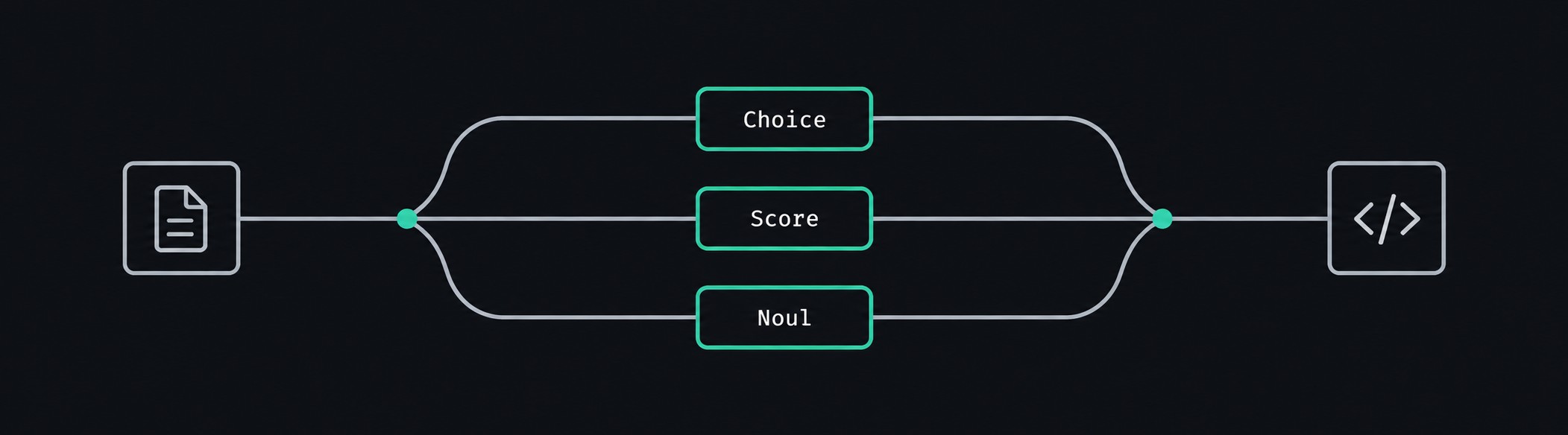
TypeSafe says Jev is not a large language model (LLM); in reinforcement learning (RL) environments, it can select actions but does not directly generate text or code. Its documentation, checked September 19, 2026, defines 3 decision types: Choice, Score, and Noul, for selecting an option, rating a scale, and estimating whether a statement is true. Application code turns those answers into actions. That makes Jev a candidate for routing requests, choosing tools, or deciding when to escalate. It cannot replace the generative component of a coding or writing task. An RL environment presents observations, accepts actions, and rewards their consequences. It can therefore evaluate either kind of model, provided the task fits. The useful comparison is whether each system completes the same work with less cost or delay, using the same evidence and success criteria.
Key Takeaways
- TypeSafe’s September 15, 2026 launch proposes a decision model for software; its internal architecture remains incompletely disclosed.
- As of September 19, 2026, customers can configure Jev’s questions but cannot fine-tune its weights.
What kind of model is Jev?
TypeSafe calls it a System One model: a model trained for focused software decisions. Founder Diogo Almeida’s September 15 announcement describes a new architecture and Reinforcement Learning for Calibrated Decisions (RLCD), its training method for judgments that reflect uncertainty.

Photo: TypeSafe AI team page; photographer unlisted
Photo source: TypeSafe AI’s team page.
The company’s AI primer discusses RLCD as a way to adapt pretrained language models. The reviewed material does not disclose Jev’s underlying structure or starting model. Its API establishes what it returns, not how it is built.
“Jev can't generate text”
Almeida describes Jev's output limitation in the launch thread.
How does Jev fit into an RL environment?
Jev selects an allowed action; code executes it; the environment checks the result. A policy is the rule or model that chooses actions from observations. The Gymnasium interface supports policies without requiring language generation.
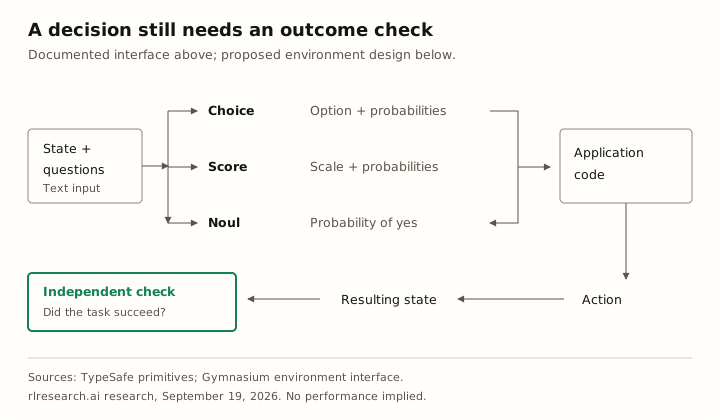
In a proposed support task, Jev could choose whether to request evidence, authorize an eligible refund, or escalate. Code would execute the choice and verify the account state. An LLM could also draft the customer response.
For a fair comparison, give both systems the same evidence, tools, and starting state. Record any help supplied by code, including preselected actions. Otherwise, the comparison rewards the surrounding software as well as the model without distinguishing them.
Where are the practical opportunities?
Our judgment is that the clearest opportunities are routing, escalation, and evaluation cases built around decisions. TypeSafe’s routing pattern already describes choosing among ordinary code, an LLM, and a human. For environment builders, that suggests:
- Routing tasks: test whether a decision model sends each request to a capable handler. Measure completion, total cost, and response time.
- Escalation tasks: test whether the model requests missing refund evidence, proceeds when eligibility is established, and escalates cases outside its authority. Check uncertainty thresholds against observed outcomes.
- Evaluation case sets: include missing evidence, ambiguous instructions, and misleading text. Grade against independently established ground truth.
These are proposed uses, not measured Jev gains. TypeSafe’s model documentation says customers cannot fine-tune Jev. Training would need to update a separate component; evaluating a fixed Jev policy is not itself RL training.
What still needs independent testing?
Task completion still needs independent testing. TypeSafe’s workflow evaluation measures agreement with reference answers derived from GPT-6 Astra and Claude Fable 5.1, assuming the surrounding code is correct. It does not independently verify business outcomes.
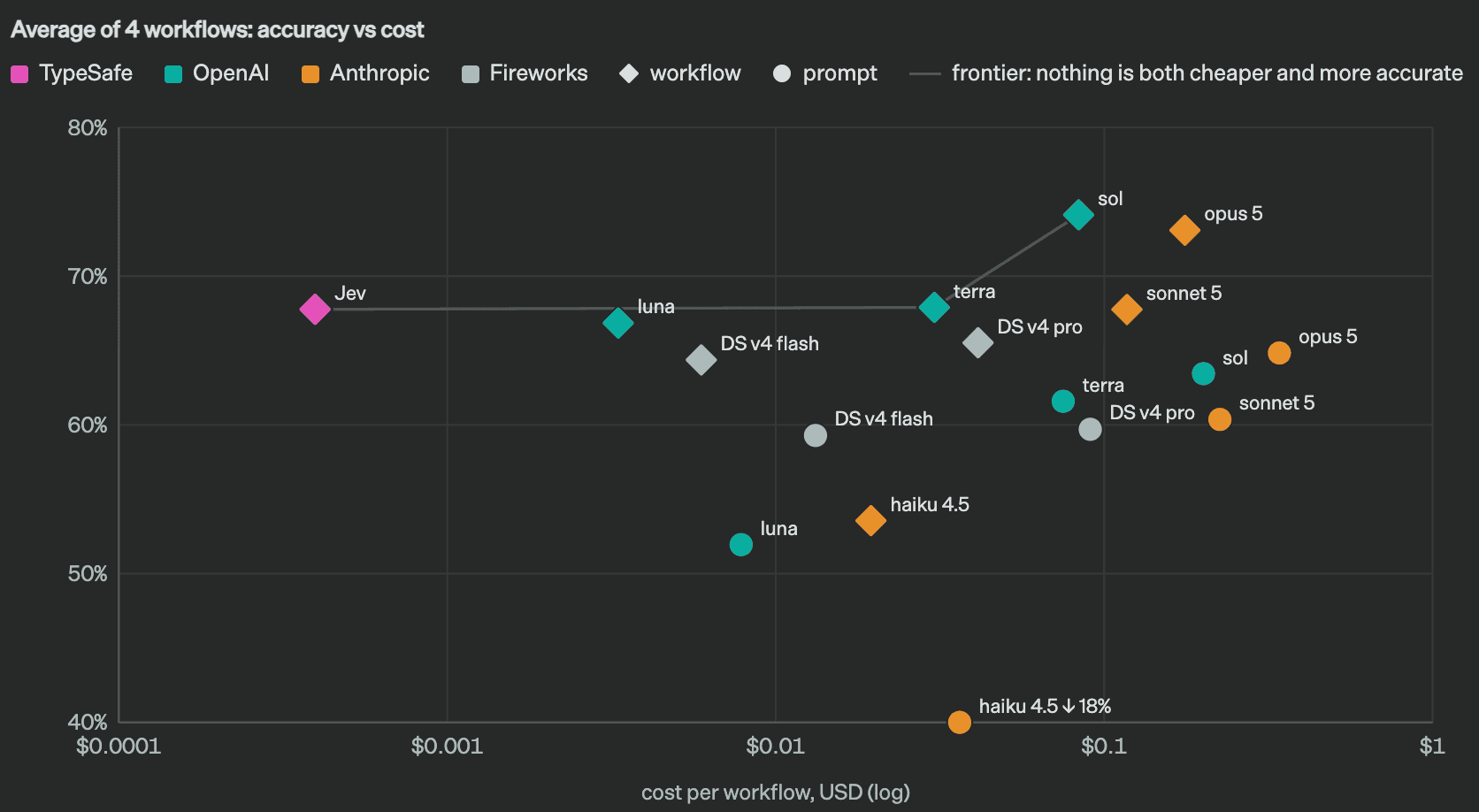
Chart: TypeSafe AI, September 15, 2026 · source
TypeSafe’s September 17 limitations review identifies arithmetic, date, and adversarial-input failures. Its confidence score summarizes the answer distribution; it does not certify correctness. If Jev helps grade another agent, check for reward hacking: earning reward without doing the intended work.
What this means
Start with a task whose allowed actions and success conditions are explicit. Compare a decision model, an LLM, and a combined system on completed work, including human review and failures in the cost. Adopt the simpler system only if that comparison supports it.
FAQ
Can Jev replace an LLM?
It may replace a call used only to classify, select, or score. It is not designed to write replies or programs. Whether the substitution helps requires testing on the actual task.
Does type safety guarantee the right decision?
No. It restricts the answer’s form and allowed values. The model can still select the wrong valid option, so the environment must check the resulting state.