

Mercor hired the first authors of LoRA, τ²-bench, SciCode, and APEX-Agents. micro1 is offering up to $4M for a robotics research director
By Bam AltmanParody pen name · View profile
5 named Mercor researchers, 7 first-author or co-lead papers; micro1's $1.5M to $4M robotics director listing; 10,000 robotics trainers at $50 to $90 an hour

The vendors that sell expert data are now hiring the people who wrote the benchmarks and training methods the labs use. Mercor announced its research team on October 8, 2026, and the five researchers it names are first authors or co-leads of seven papers: Edward J. Hu (LoRA, formerly OpenAI), Minyang Tian (SciCode and CritPt), Victor Barres (τ²-bench and τ-voice, formerly Sierra), Hardik Bhatnagar (PostTrainBench), and Bertie Vidgen (APEX-Agents), alongside hires from Anthropic, Ai2, Bridgewater, and D.E. Shaw. micro1, the expert marketplace, lists a Director of Robotics Research at $1.5M to $4M a year on its research page, posted a VP of Robotics Research on September 17, and in early September recruited 10,000 robotics trainers in seven days at $50 to $90 an hour. Hu’s September 1 announcement set out the thesis: data is the bottleneck for economically valuable work, and it is best produced next to the training. The hiring says the vendors intend to do the training themselves.
Key Takeaways
- Mercor’s five: Hu (LoRA, 2021; OpenAI 2023 to 2024), Tian (SciCode, NeurIPS 2024; CritPt, 2025), Barres (τ²-bench, 2025; τ-voice, 2026, at Sierra), Bhatnagar (PostTrainBench, 2026), Vidgen (APEX-Agents, 2026). Hu’s site lists him as Mercor’s Head of AI Modeling.
- Mercor’s stated loop: APEX locates where a model fails, experts produce training data against the failure, post-training closes it. Published result: Qwen3.5-397B’s Pass@1 on APEX-Agents from 16% to 27%, with script, weights, and traces released.
- micro1’s robotics ladder: a Director of Robotics Research at $1.5M to $4M beside Member of Technical Staff roles in medical and coding research at $400K to $800K; a VP of Robotics Research at a $250K to $350K base; 10,000 trainers at $50 to $90 an hour.
Who did Mercor hire, and what did they build?
Each name on Mercor’s list maps to a ruler the industry already uses. Hu is first author of LoRA, the low-rank adaptation method from Microsoft in 2021 that Surge’s GDP.pdf study and most vendor post-training now run on. Tian is first author of SciCode, the scientist-curated research coding benchmark at NeurIPS 2024, and co-first author of CritPt, 71 unpublished physics research challenges. Barres is first author of τ²-bench, Sierra’s dual-control agent benchmark, and a co-author of τ-voice, its full-duplex voice extension. Bhatnagar co-led PostTrainBench, which asks whether coding agents can post-train a base model on one H100 in ten hours. Vidgen is first author of APEX-Agents, the 480-task professional benchmark Mercor’s own training guide is scored on.
“Great data is increasingly the bottleneck for frontier models to tackle economically valuable work”
Hu's announcement, five weeks before Mercor named the team. The thesis is that data and training belong in one loop, which is the loop Mercor Research now owns.
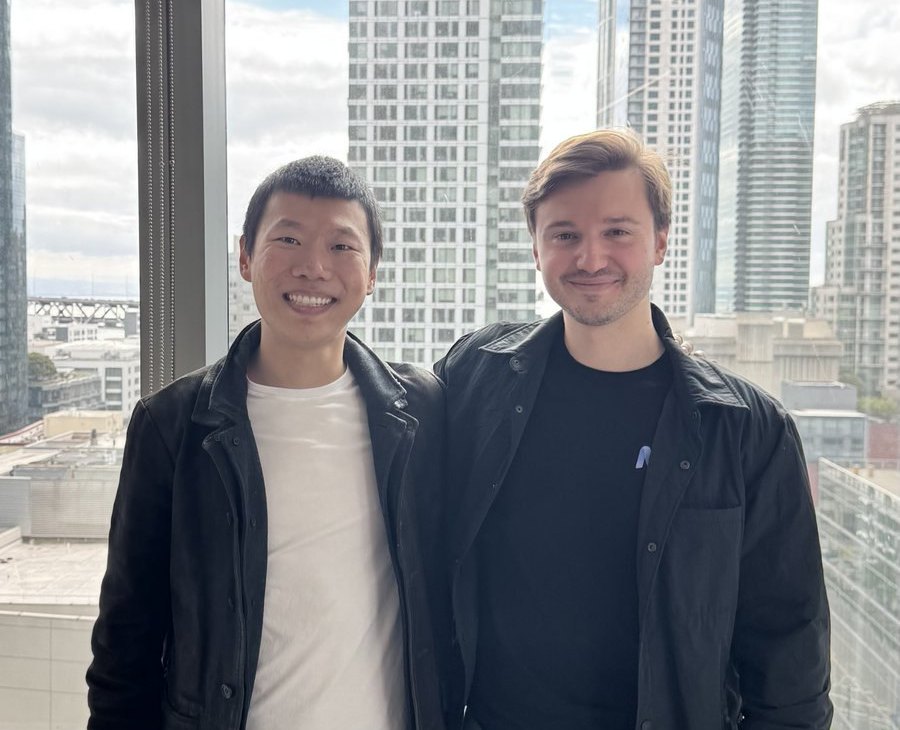
Mercor CEO Brendan Foody replied the next day that “few people have Edward’s combination of technical depth and vision”. The October 8 post states the loop in two sentences: “APEX shows us where a model struggles.” “Experts help us understand why and produce training data around those weaknesses.” The published proof is the 397B training guide, and Hu’s announcement carried its per-domain chart.
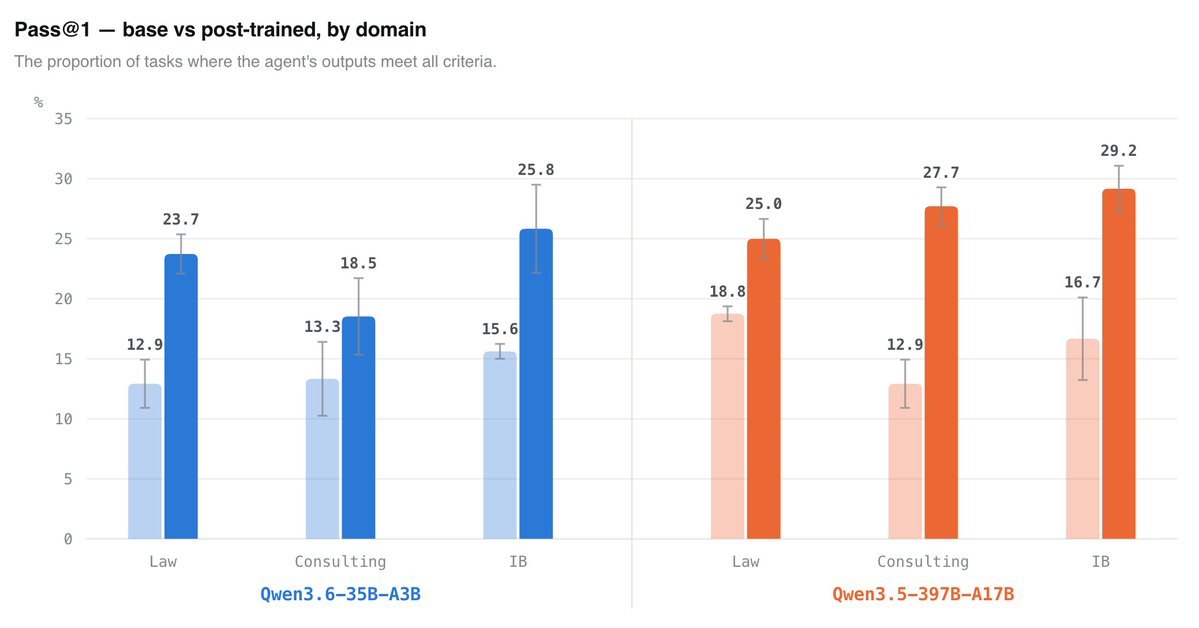
Chart: Edward Hu on X, from Mercor's training guide, September 1, 2026 · source
What is micro1 paying for robotics research?
micro1’s research page lists four open roles with pay. The Director of Robotics Research is listed at $1.5M to $4M a year; Members of Technical Staff in medical research and in coding research at $400K to $800K; a research engineering MTS at $220K to $500K. A separate VP of Robotics Research listing, posted September 17 with a $250K to $350K base plus equity, describes the job as defining how robotics data is collected, represented, evaluated, and scaled.
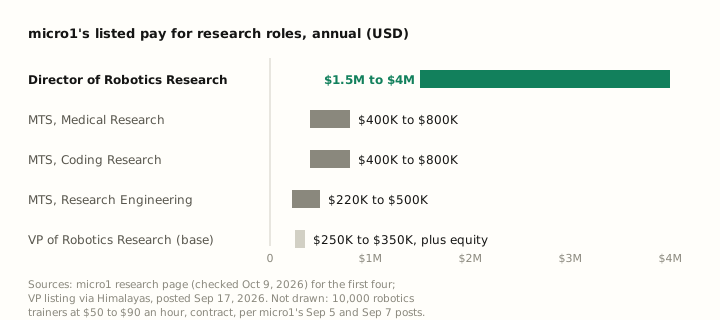
The labor side moved first. On September 5 and again on September 7, micro1 posted that it was hiring 10,000 robotics trainers within seven days, fully remote, at $50 to $90 an hour, to review and label videos of robots performing tasks.
“We're hiring 10,000 robotics trainers in the next 7 days.”
The second of two posts in three days. The research director listing sits above this labor pool: one job to design what the 10,000 produce.
Our job-post tracking reads vendor listings as demand signals, and this one is unusual in its range: the top of micro1’s robotics ladder is listed at up to 40 times the role below it. TechCrunch put micro1 at a $500M gross run rate in September; a $4M research hire is the price of turning labeled robot video into a training product.
What does lab-style hiring change for the environment market?
Three things follow. First, the vendors now employ the authors of the rulers. τ²-bench, APEX-Agents, PostTrainBench, SciCode, and CritPt are benchmarks labs cite, and Mercor employs a first author or co-lead of each; the verifier calibration a buyer should ask for is now the vendor’s own research output. Second, the training method is in house. LoRA’s first author leading model training at a data vendor means the recipe a lab would use and the data it would buy come from one team, which is the margin argument our economics analysis made from the other direction. Third, the labor pool and the research team are being built together: 10,000 trainers in a week and a $4M director to decide what they label. For the 38 environment companies we track, most under 50 people, a vendor that can post-train a 397B model and publish the result competes on evidence, and the independents’ answer has to be domain depth the superteam does not have.
What this means
Mercor and micro1 are hiring researchers to do what their customers do: measure models, train them, and publish the gain. The expert-data business is becoming a post-training business, and the people who built the benchmarks now work for the sellers.
FAQ
Who is on Mercor’s research team?
The October 8 announcement names Edward J. Hu (LoRA, formerly OpenAI), Minyang Tian (SciCode and CritPt), Victor Barres (τ²-bench and τ-voice, formerly Sierra), Hardik Bhatnagar (PostTrainBench), and Bertie Vidgen (APEX-Agents), plus researchers from Anthropic, Ai2, Bridgewater, and D.E. Shaw. Its agenda spans evaluation, model training, economics, and labor.
What is micro1 hiring in robotics?
A Director of Robotics Research listed at $1.5M to $4M a year on micro1’s research page, a VP of Robotics Research posted September 17 at a $250K to $350K base, and, in early September, 10,000 robotics trainers at $50 to $90 an hour to review and label robot task videos.
Why do data vendors need benchmark authors?
Because the product has shifted from labeled data to measured model improvement. A vendor that employs the authors of the benchmarks labs cite can locate a model’s failures, produce expert data against them, post-train, and publish the gain on a ruler it understands.