
Training AI on office work made it better at coding
By Satya NutellaParody pen name · View profile
+5.8 points on SWE-Bench Pro from training on office work

Environment training transfers across domains. On August 3, 2026, Surge AI, the data-labeling and evaluation vendor, reported that a model (Qwen3.5-122B-A10B) post-trained on office tasks with no coding in the mix gained 5.8 points on SWE-Bench Pro, a coding benchmark the model was never trained on; Surge published the delta, not the baseline score. The post-training mix was documents, spreadsheets, web research, planning, and tool use across office services. Surge reads the gain as transferable goal-directed execution: planning, multi-step execution, error recovery, and producing a verifiable output. The result is vendor-reported and not yet independently replicated. If it holds, it changes what labs are buying: an environment’s value is measured by the execution it demands rather than by domain overlap with the target benchmark. AfterQuery reports in-domain expert-data uplifts on τ²-Bench, not cross-domain transfer, and transfer raises the stakes on contamination controls, the checks that a training environment shares no structure with the evaluation benchmark.
Key Takeaways
- A model post-trained on documents, spreadsheets, web research, planning, and tool use, with zero coding tasks, gained 5.8 points on SWE-Bench Pro (Surge AI, August 3, 2026).
- RL post-training generalizes out-of-distribution where supervised fine-tuning memorizes (SFT Memorizes, RL Generalizes, 2025; Huan et al., 2025).
- If environments train execution rather than domain knowledge, labs should buy the hardest execution challenges available, and domain overlap stops being the purchase criterion.
What did Surge report?
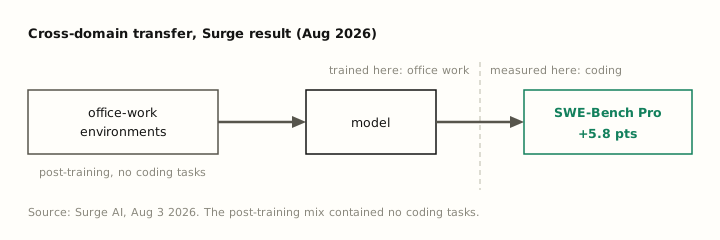
Surge’s reading is that training goal-directed execution in one domain improves performance in another because the underlying competency is the same.
SFT Memorizes, RL Generalizes showed RL post-training holding up out-of-distribution where supervised fine-tuning collapses into memorization, and a 20-model study of reasoning transfer found the same asymmetry in the other direction: RL-tuned math models carried their gains to general tasks while SFT-tuned ones drifted and forgot (Huan et al., 2025). Office work to coding is the same claim applied to a commercial benchmark.
What did earlier work show?
Surge’s earlier cross-benchmark generalization work, published May 28, 2026, showed agentic-environment training transferring to Toolathlon, τ²-Bench, and BFCL-V4, benchmarks spanning tool use, multi-turn agent interactions, and function calling. The pattern is consistent: environment training that produces goal-directed execution transfers to benchmarks that require it.
AfterQuery, the expert-data vendor, reports expert-data uplifts on τ²-Bench and a +21.4% GDPval gain via on-policy distillation, which trains a student model on its own outputs with a teacher’s feedback. The shared finding: expert-generated signal, whether rubrics or environments, improves model performance on the target benchmark; only Surge has reported cross-domain transfer.
What does this mean for buyers?
If environments train execution rather than domain knowledge, the value of an environment is not measured by domain overlap with the target benchmark. An office-work environment improves coding performance; a finance environment might improve legal performance. Labs are buying general execution capability.
The buyer’s logic, if transfer holds:
- If environments were domain tutors, a lab would need one environment per domain.
- If environments train execution, a lab needs the hardest, most realistic execution challenges, and the domain is secondary.
- The 31-to-1 benchmark-to-environment ratio understates the leverage, because one good environment can improve performance across many benchmarks.
“we trained a model on our coding dataset”
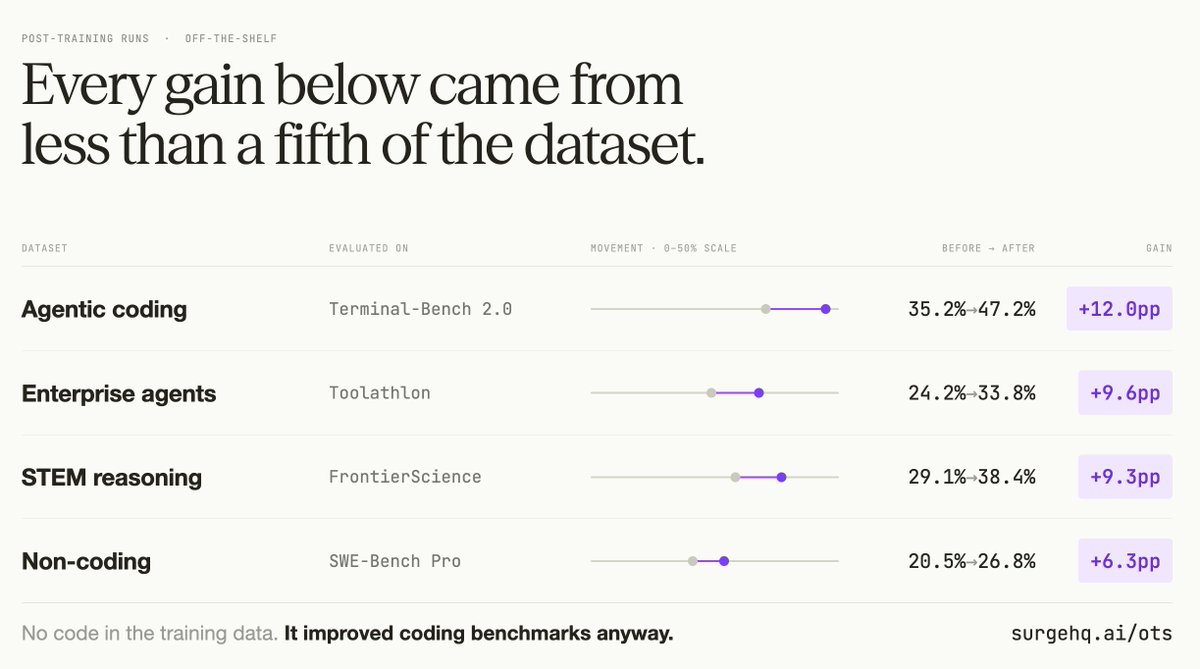
The bottom row is the transfer result: a non-coding dataset moving a coding benchmark. Surge published the per-dataset breakdown three days before the office-work post.
What this means
If it holds, transfer makes environments more valuable than domain-specific data and raises the stakes on contamination controls. If an environment leaks test structure, the transfer carries the leak rather than the competence, and who defines the ground truth the environment grades against decides which of the two a lab bought.
FAQ
What is SWE-Bench Pro?
SWE-Bench Pro is Scale AI’s contamination-resistant, long-horizon successor to SWE-bench: 1,865 enterprise-grade software engineering problems across 41 repositories. Surge AI’s August 3, 2026 result showed a model post-trained on office work with no coding tasks gaining 5.8 points on it.
What is goal-directed execution?
Goal-directed execution is the ability to plan, execute multi-step workflows, recover from errors, and produce a verifiable output. It is domain-general: the same execution skills that resolve an office-work task also resolve a coding task, which is why environment training transfers.
Why does this raise contamination concerns?
If a training environment contains patterns that also appear in the evaluation benchmark, the improvement reflects memorized structure rather than skill. A model that appears to improve on SWE-Bench Pro may have memorized structure from a contaminated office-work environment. Contamination controls separate real transfer from leakage.